For insurance
FNOL, renewals and underwriting intake, captured on the first call.
Voice agents that take the claim, work the renewal book and collect risk detail, on a stack that records every word.
No policyholder waits on hold to report a loss.
Every line answered on the first ring, during the surge and at 2am alike.
The claim is structured before an adjuster picks it up.
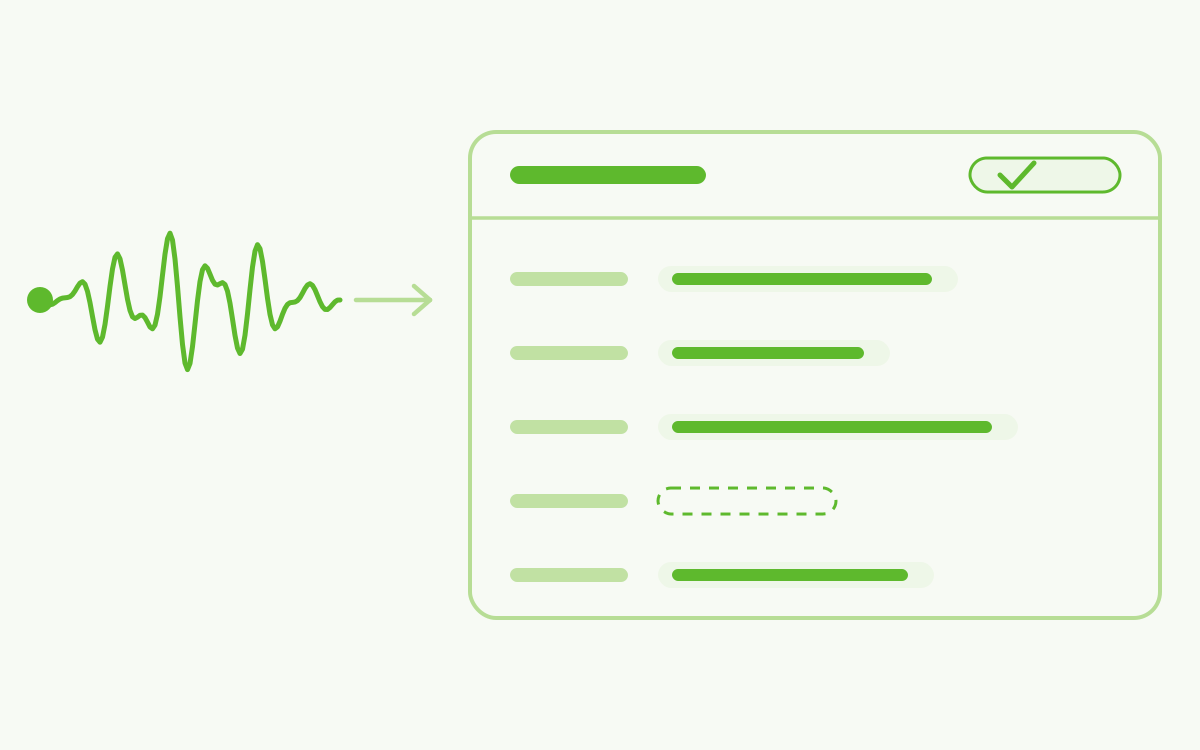
Guava collects every required field immediately after the incident and creates a structured FNOL record, so the first human to touch the claim is assessing it rather than transcribing it.
Capture it while it is fresh
The first call happens when the detail is sharpest, not after a callback queue has aged it by a day.
A record, not a recording
Structured fields in your claims system. A transcript is not the deliverable.
Surge is a volume problem, not a hiring problem
Every line answered at once when a weather event triples the inbound.
The renewal book gets called. All of it.
Guava contacts policyholders before the renewal date to confirm coverage, walk through an updated quote and surface the bundle or umbrella conversation that only happens when somebody has time to have it.
Every policy, not the top decile
The whole book gets a call, including the accounts too small to justify an agent's hour.
Upsell where it is relevant
Bundling and umbrella raised on the calls where the coverage gap is real.
Warm, not scripted at
A conversation the policyholder can interrupt, in their own language.
Risk detail collected without the back-and-forth.
The detailed risk information a new policy or endorsement needs, gathered on a call instead of across a week of emails between the agent and the applicant.
One pass instead of five
The follow-up questions get asked in the same call rather than in the next email.
Complete submissions
Missing fields are chased on the call, so underwriting receives something it can actually work.
Auditable end to end
Transcript, fields, disclosures and outcome recorded per call.
The audit trail a claims file has to survive.
The certifications a carrier's risk team checks, and the controls behind them.
SOC 2 Type II
Independently audited controls, with the report available under MNDA.
HITRUST i1 certified
The implemented, one-year certification, stricter than the legacy CSF baseline.
PCI DSS Level 1
For any payment or account detail taken on the call.
Auditable per call
Transcript, structured fields, disclosures and outcome recorded for every call, so a review is a query rather than an investigation.
Disclosures verbatim
The scripted part of the call delivered identically every time, which is the part a human drifts on.
Live in 14 days
Kickoff to real traffic in two weeks, on a stack that has carried regulated calls since 2013.
Where it runs across the policy lifecycle.
Six voice workloads where FNOL quality, policy-system writeback, and NAIC-grade governance all have to hold.
FNOL intake
property, auto, workers' comp
Claims status and follow-up
Policy servicing and renewal
Premium payment and billing
Underwriting triage
Health-plan member services
What underwriting and compliance will ask.
How long does a deployment take?
14 days from kickoff to a live call for a production-grade deployment. That is real traffic, not a sandbox or a proof of concept.
Does Guava replace our team?
No. Guava takes the calls that do not need a person and escalates the ones that do, with the full call context attached. Your people keep the conversations where judgement is the point.
What certifications does Guava hold?
SOC 2 Type II, HITRUST i1 and PCI DSS Level 1. Reports are available under MNDA. A BAA is available where protected health information is involved.
How does Guava integrate with our systems?
Through code, not prompts. Your systems stay the source of truth; Guava reads live and writes the outcome back rather than holding a second copy.
What languages does Guava support?
Calls run in the customer's own language.
Hear it take an FNOL call.
14 days from kickoff to live traffic, on a stack that has carried regulated calls for over a decade.